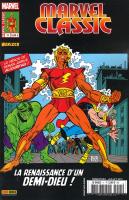
Adam Warlock
From Wikipedia, the free encyclopedia
| Adam Warlock | |
|---|---|
Warlock #9 (Oct. 1975). Cover art by Jim Starlin. |
|
| Publication information | |
| Publisher | Marvel Comics |
| First appearance | (as Him) Fantastic Four #66-67 (Sept.-Oct. 1967) (as Adam Warlock) Marvel Premiere #1 (April 1972) |
| Created by | Stan Lee & Jack Kirby |
| In-story information | |
| Alter ego | Him |
| Team affiliations | Guardians of the Galaxy Infinity Watch |
| Notable aliases | Magus |
| Abilities | Superhuman strength; stamina; agility; endurance; flight; Energy manipulation |
Adam Warlock, originally known as Him, is a fictional character that appears in comic books published by Marvel Comics. The character first appeared in Fantastic Four #66 (Sept. 1967) (in cocoon form) and #67 (Oct. 1967), (in humanoid form) and was created by Stan Lee and Jack Kirby.
Debuting in the Silver Age of comic books, the character has appeared in over four decades of Marvel publications, and starred in the popular titles Marvel Premiere and Strange Tales; five self-titled volumes and several related limited series. Adam Warlock has also been associated with Marvel merchandise including clothing; toys; trading cards; animated television series and video games.
Contents |
[edit] Publication history
[edit] 1960s to 1970s
The character debuted in Fantastic Four #66-67 (Sept.-Oct. 1967) in a story written by Stan Lee and pencilled and co-plotted by Jack Kirby. Established as an artificial human called Him, the character was created for personal gain and power by the scientific group the Enclave. The superhero team the Fantastic Four, rescuing their friend Alicia Masters from the Enclave's island base, escape together when Him "hatches" from his cocoon and destroys the island. Him abandons his masters and departs Earth for space.
After a final appearance as "Him" in Thor #165-166 (June-July 1969), writer and then Marvel editor-in-chief Roy Thomas and penciler Gil Kane significantly revamped Him as the allegorical Messiah Adam Warlock in Marvel Premiere #1 (April 1972). The High Evolutionary, a master of genetics, evolved Him to a more advanced state of being and rechristened the character "Adam Warlock" in Marvel Premiere #2 (May 1972). Thomas in 2009 explained he had been fan of the soundtrack to the musical Jesus Christ Superstar and sought to bring the story to comic books in a superhero context: "Yes, I had some trepidation about the Christ parallels, but I hoped there would be little outcry if I handled it tastefully, since I was not really making any serious statement on religion ... at least not overtly."[1] Choosing to use a preexisting character while keeping the series locale separate from mainstream Marvel Earth, he created Counter-Earth, a new planet generated from a chunk of Earth and set in orbit on the opposite side of the sun.[2] Thomas and Kane collaborated on the costume, with the red tunic and golden lightning bolt as their homage to Fawcett Comics' 1940s-1950s character Captain Marvel.[2]
The story continued in the series The Power of Warlock, which ran eight issues (Aug. 1972 - Oct. 1973), with Warlock also making an appearance in The Incredible Hulk vol. 2, #158 (Dec. 1972). In a 2009 retrospective survey of the character, writer Karen Walker said the series
"...continued the story of Adam's attempts to drive the [the fallen-angel figure the] Man-Beast out of Counter-Earth, but drifted toward standard superhero stories with pseudo-Biblical references injected into them. Warlock spends much of his time trying to convince the High Evolutionary not to destroy the planet, and the rest of his time battling the Man-Beast and his minions. Although the concept of a superhero savior was still present, it often came across as forced, and certainly contradictory to the idea of a pacifistic savior. It's questionable whether the concept could really work in a medium driven by physical conflict."[3]
After this storyline is resolved in The Incredible Hulk vol. 2, #176-178 (June-Aug. 1974), writer-artist Jim Starlin revived Warlock in Strange Tales #178-181 (Feb.-Aug. 1975). Warlock's adventures became more cosmic in scope as Starlin took the character through an extended storyline referred to as "The Magus Saga",[4] which continued in Warlock #9 (Oct. 1975), the reimagined title continuing the numbering of The Power of Warlock. This bimonthly series, written and drawn by Starlin, who was eventually assisted by co-penciler and inker Steve Leialoha, ran seven issues. It chronicled Warlock's conflict with his future demagogue self, the Magus, and his religious empire, culminating in issue #12. A final story arc dealt with Warlock's battle with the entity the Star Thief before this series was canceled with issue #15 (Nov. 1976).
Starlin, in a 2009 interview, recalled,
"I had quit [the cosmic superhero series] Captain Marvel over a dispute at that point, but I settled the dispute with Marvel and I was going to come back [to that title]. But [a different team was in place]. So Roy [Thomas] asked me [what character] I wanted to do. So I went home that night and pulled out a bunch of comics. I came across, in the Fantastic Four, Him, and came back the next day and said that's who I wanted to do., and that night I started working on it. ...I had basically taken Captain Marvel, a warrior, and turned him into sort of a messiah-type character. So when I got to Warlock, I said to myself, 'I got a messiah right here to start off with; where do I go from there?' And I decided a paranoid schizophrenic was the route to take."[5]
Warlock's adventures were reprinted, with new Starlin covers, in the six-issue limited series Special Edition on Warlock (Dec. 1982 - May 1983).[6] This reprint series was itself reprinted, with yet another set of new Starlin covers, as Warlock vol. 2 (May-Oct. 1992).[7]
Warlock then made three connected appearances: Marvel Team-Up #55 (March 1977) with the superhero Spider-Man; and the first "Thanos War", across The Avengers Annual #7 (1977) and Marvel Two-In-One Annual #2 (1977). The last story featured Warlock's death and brief resurrection, and his return from the world of the Soul Gem, before his disappearance from from Marvel continuity. Although regarded as deceased, Warlock made a brief appearance in a Marvel Two-In-One #61-63 (March-May 1980), albeit as a soulless, inanimate shell.
[edit] 1990s revival
Eleven years later, Starlin revived the character and two members of his supporting cast in the miniseries Infinity Gauntlet #1-6 (July-Dec. 1991). This plot development was a continuation of a larger storyline that began with the resurrection of Thanos in Silver Surfer vol. 3, #34 (Feb. 1990).
Following the events of the The Infinity Gauntlet (July-Dec. 1991), Warlock and several compatriots starred in the series Warlock and the Infinity Watch. Written by Starlin and drawn initially by Angel Medina, it ran 42 issues (Feb. 1992 - Aug. 1995). Many of the early storylines continued to focus on the Infinity Gems and the consequences of their use in the Marvel Universe, with plots tying into two related limited series, The Infinity War (June-Nov. 1992) and The Infinity Crusade (June-Dec. 1993).
Warlock starred in several limited series, including Silver Surfer/Warlock: Resurrection #1-4 (March-June 1993); The Warlock Chronicles #1-8 (July 1993 - Feb. 1994); and Warlock vol. 3, #1-4 (Nov. 1998 - Feb. 1999), by writer-penciler Tom Lyle.[8] The character also featured in the intercompany crossovers between Marvel Comics and the Malibu Comics Ultraverse in the one-shot Rune / Silver Surfer (April 1995 in indicia, June 1995 on cover); Rune vol. 2, #1-7 (Sept. 1995 - April 1996); and the two-issue Ultraverse Unlimited (June & Sept. 1996).
Following the unrelated, 1999-2000 series Warlock vol. 4, featuring the alien cybernetic character Warlock of the team the New Mutants,[9] Adam Warlock co-starred with Thanos in the limited series The Infinity Abyss #1-6 (Aug.-Oct. 2002; published biweekly); Marvel Universe: The End #1-6 (May-Aug. 2003; first four issues biweekly); and Thanos #1-6 (Dec. 2003 - April 2004; two issues biweekly). A version of the character starred in the four-issue limited series Warlock vol. 5 (Nov. 2004 - Feb. 2005), by writer Greg Pak and artist Charles Adlard. Warlock undergoes changes in the miniseries Annihilation #1-6 (Oct. 2006 - March 2007), and is featured in the subsequent Annihilation Conquest: Quasar #1-4 (Sept.-Dec. 2007) and Annihilation Conquest # 1-6 (Nov. 2007 - April 2008) before joining the titular heroic team in Guardians of the Galaxy vol. 2, #1 (July 2008). A storyline in Guardians of the Galaxy vol. 2, #17-19 (Oct.-Dec. 2009) has Warlock adopting the alias of the Magus, and eventually being killed by a Guardians team-mate.
Artist Alan Weiss recalled in a 2006 interview there was a "lost" Adam Warlock story, which if completed would have been reminiscent of the Jonathan Swift novel Gulliver's Travels.[10]
[edit] Fictional character biography
[edit] Creation, Metamorphosis, and Death
After his birth and escape from the Enclave and Earth, Him is revealed to have been caught in an asteroid shower and saved by cosmic entity the Watcher, who sends the artificial being back to Earth. Discovering the Asgardian goddess Sif, Him decides to take her as his mate, which incites the fury of the Norse god and superhero Thor. Him subsequently escapes Thor by creating another cocoon around himself.[11]
Found by the High Evolutionary, the entity is evolved to a higher state of being and rechristens him "Adam Warlock": "Adam", for being the first of his kind, and "Warlock", because humanity would fear his power. The High Evolutionary also bestows on Warlock the green Soul Gem (eventually revealed to be one of the six Infinity Gems), a gem with the power to suck the souls from opponents. Warlock's mission is to stop the High Evolutionary's flawed creation, the Man Beast, on Counter-Earth, the High Evolutionary's copy of the original Earth. A protracted war ensues,[12] with the monster the Hulk aiding Warlock on two separate visits to Counter-Earth. Although the Man-Beast captures and tortures a crucified Warlock, he is reborn and reverts the Man-Beast back into wolf form. With the chaos on Counter-Earth at an end, Warlock departs for space.[13][14]
In another galaxy, Warlock learns of the Universal Church of Truth, an intergalactic religious empire presided over by a mysterious figure known as the Magus.[15] Eventually meeting and befriending the alien Pip the Troll[16] and female assassin Gamora,[17] Warlock opposes the Church, despite opposition from the Church's Matriarch and soldier-priests the Black Knights.[18] The Machiavellian alien Thanos, Gamora's employer, appears and claims he will aid Warlock to stop the Magus. Warlock, unaware of Thanos' attempt to rule the universe with the reality-changing Cosmic Cube,[19] accepts.
During his first encounter with the Magus, Warlock discovers the entity is in fact his futuristic evil alter ego, who tells Warlock his constant use of the Soul Gem brings him closer to being the Magus.[20] Thanos engages the Magus in personal combat while Warlock encounters the cosmic entity the In-Betweener, who has been sent to esnure that Warlock becomes the Magus.[21] Warlock, however, succeeds in altering his personal timeline by killing a version of himself that exists a few months into the future. Knowing that he will in turn die, Warlock prevents the Magus from ever existing.[22] Warlock also encounters the villain the Star Thief, a comatose and human hospital patient whose subconscious is capable of destroying entire stars.[23]
Denied a homecoming to Earth after a protracted battle with the Star Thief, Warlock struggles to control the vampiric Soul Gem.[24] After rescuing the hero Spider-Man from a rocket in space, the pair thwart the cosmic entity the Stranger, who attempts to steal the Soul Gem. The heroes also discover the existence of the other gems.[25]
Warlock returns to Thanos' vessel to find Gamora dying and Pip's mind destroyed by Thanos. The Eternal has secretly collected the five other gems and been draining the energies of the Soul Gem without Warlock's knowledge, using the power from all six artifacts for a weapon capable of destroying a star. Thanos, still pining for the entity Death - who abandoned him after his previous failure - intends to extinguish every star in the universe as an offering to the entity. Warlock travels to Earth and enlists the aid of the superhero team the Avengers; the Kree hero Captain Marvel; and heroine Moondragon. After an exhaustive battle between Warlock's allies and Thanos' mercenary fleet, Thanos mortally wounds Warlock. Captain Marvel witnesses Warlock's soul being taken by his temporally displaced previous self, a feat Warlock had arranged in the past to stop the Magus from existing. Avengers Thor and Iron Man force Thanos to retreat, but with Captain Marvel are eventually defeated. The cosmic entities Lord Chaos and Master Order intervene, and via a subconscious message draw Spider-Man and Fantastic Four member the Thing into the battle. Spider-Man frees the fallen heroes, and then makes contact with the Soul Gem, releasing the spirit of Warlock. A newly empowered Warlock turns Thanos to stone before returning to the Soul Gem, finally ending the threat.[26]
Fellow Enclave creation Her becomes intent on finding Warlock, as she was created to be his mate. Aided by the Thing; Moondragon and Guardians of the Galaxy member Starhawk, Her locates Warlock's corpse, but abandons any hope of Warlock being her mate, as his mind and soul are gone.[27]
[edit] Rebirth
Believing the balance in the universe is too heavily in favour of life, Death resurrects Thanos,[28] who decides to win "her" favour" by performing a cosmic feat. The Eternal finds and humbles the Elders of the Universe (killing the Elder the Gardener) and the entity the In-Betweener, taking from them the Infinity Gems.[29] Taking the Soul Gem inadvertently revives Adam Warlock, who senses Thanos' rebirth. Warlock also brings to souls of Pip and Gamora, and they are able to re-enter the material world by assuming control of three recently deceased humans.
Thanos uses the Gems, which he mounts on his left glove as the Infinity Gauntlet, to erase half the population of the universe. After Thanos defeats a cosmic hierarchy that includes Galactus; the Celestials, and Eternity, Warlock leads a group of Earth's surviving superheroes against him. The space pirate Nebula steals the Gauntlet, but after undoing all of Thanos' changes loses the Gauntlet to Warlock.[30] Warlock, however, is deemed unworthy of the Gauntlet by the entity the Living Tribunal as he is an artificial being. Warlock concedes and divides the Infinity Gems among himself and his companions — Pip; Gamora; Drax the Destroyer; Moondragon; and a reformed Thanos — the group being called the Infinity Watch.[31]
Warlock's temporary possession of the Gauntlet has unforeseen consequences: in attempting to control his emotions, the character purges all good and evil from his being, leaving him entirely as a creature of logic. The "moral" aspects of his persona in turn take on physical forms — the evil half becomes a new incarnation of the Magus, while the good half becomes the self-styled Goddess. Warlock, aided by an army of superheroes, eventually defeats each in turn, and absorbs them into the Soul Gem.[32][33]
Warlock and a multitude of superheroes also team with Thanos to defeat several rogue clones of the Eternal,[34] and Warlock eventually convinces Thanos to destroy and recreate the universe to fix a fundamental flaw.[35] Warlock also assists in Thanos' attempt at redeeming himself.[36]
[edit] Annihilation and the Guardians
Warlock is incapacitated by the backlash of souls killed during the "Annihilation" storyline, and re-enters hibernation in a cocoon.[37] The superheroines Quasar and Moondragon awaken Warlock as he is to be the prophesied "Savior of the Kree" who will deliver them from the fellow alien race the Phalanx.[38] Warlock, however, is disoriented due to being awakened prematurely and also now wears a costume reminiscent of the Magus. The leader of the Phalanx possesses Adam Warlock, but is eventually driven from his body by the cybernetic Warlock of the New Mutants. Adam Warlock's soul, stored in Quasar's quantum bands, is then returned to his body. Once the Phalanx is defeated, Warlock agrees to join the hero Star Lord in forming a team to deal with galactic threats.[39] They form a new version of the Guardians of the Galaxy.[40]
When Warlock is forced to merge two realities to restore the universe, altering the timeline forces the Magus persona on him. As the Magus, Warlock slaughters many of the Guardians and reveals that due to the change in the timeline he has been the Magus for several months. Star Lord uses the Cosmic Cube to stop Warlock, and kills a temporarily sane Warlock when he begs for death.[41]
[edit] Powers and abilities
As Him, the character possessed superhuman strength; speed; durability; stamina; agility and the ability to manipulate cosmic energy for energy projection, flight and recuperation (e.g. creating a cocoon for self-preservation and regeneration). Once Him became Warlock and acquired the green Soul Gem, the character no longer used many of the cosmic abilities. The Gem possesses a consciousness of its own and demonstrates a vampiric hunger for the life energies of organic beings. It also contains an idyllic pocket universe that hosts all the souls the Gem has ever taken. The latest version of Warlock uses "Quantum magic" and can manipulate energy; create force fields; teleport; travel faster than light and detect wormholes and other irregularities in space.
[edit] In other media
Adam Warlock appears in the video game Marvel Super Heroes: War of the Gems. A version of the character appeared in the first season of the Silver Surfer TV series (1994). Adam Warlock has also appeared as part of Marvel's OverPower collectible card game, Upper Deck's Marvel Vs. collectible card game and HeroClix collectible miniatures game, and as a Marvel Legends action figure.
[edit] Bibliography
- Marvel Premiere #1-2 (April-May 1972)
- Warlock #1-8 (August 1972 - Oct. 1973; cover title: The Power of... Warlock)
- Strange Tales 178-181 (March-June 1975)
- Hulk #176-178 (June-Aug. 1974)
- Warlock #9-15 (Oct. 1975 - Nov. 1976)
- Marvel Team-Up #55 (March 1977)
- Avengers Annual #7 (1977)
- Marvel Two-in-One Annual #2 (1977)
- Fantasy Masterpieces #8-14 (July 1980 - Jan. 1981; reprints only)
- Special Edition on Warlock #1-6 (Dec. 1982 - May 1983; reprints only)
- Warlock vol. 2, #1-6 (May-Oct. 1992; reprints only)
- Warlock and the Infinity Watch #1-42 (Feb. 1992 - Aug. 1995)
- Silver Surfer / Warlock: Resurrection #1-4 (March - Jun. 1993)
- Warlock Chronicles #1-8 (July 1993 - Feb. 1994)
- Warlock vol. 3, #1-4 (Nov. 1998 - Feb. 1999)
- Warlock vol. 5, #1 - 4 (Nov. 2004 - Feb. 2005)
- Annihilation: Conquest #1-6 (Jan. 2008 - Jun. 2008)
- Guardians of the Galaxy #1- (Jul. 2008 - )
Note: Warlock vol. 4 starred an unrelated character, a mutant alien from New Mutants.
[edit] Collected editions
The stories have been collected as part of the Marvel Masterworks series:
- Marvel Masterworks Warlock (hardcover):
- Volume 1 (collects Marvel Premiere #1-2, Warlock #1-8 and Incredible Hulk #176-178, 273 pages, January 2007, ISBN 0-7851-2411-X)
- Volume 2 (collects Strange Tales #178-181, Warlock #9-15, Marvel Team-Up #55, Avengers Annual #7, Marvel Two-in-One Annual #2, 320 pages, June 2009, ISBN 0-7851-3511-1)
[edit] Footnotes
- ^ Walker, Karen. "The Life and Death (and Life and Death) of Adam Warlock", Back Issue #34 (June 2009), p.3
- ^ a b Walker, p.4
- ^ Walker, p.5
- ^ Kingman, Jim. "Comic Effect" (column): "The Magus Saga", Comics Bulletin, September 16, 2004. archive.
- ^ Walker, p.6
- ^ Special Edition on Warlock (1982-1983) at The Unofficial Handbook of Marvel Comics Creators. Note: The Grand Comics Database uses the title Warlock (Warlock Marvel, 1982 Series), which is at odds with subsequent UHMCC volume numbers.
- ^ Warlock (II) (1992) at The Unofficial Handbook of Marvel Comics Creators
- ^ Warlock (III) (1998-1999) at The Unofficial Handbook of Marvel Comics Creators
- ^ Warlock(IV) (Mutant Alien) (1999-2000) at The Unofficial Handbook of Marvel Comics Creators
- ^ Best, Daniel "The Legendary 'Lost' Warlock" Adelaide Comics and Books, 2007
- ^ Thor #165-166 (June-July 1969)
- ^ Marvel Premiere #1 - 2 (April & May 1972); The Power of Warlock #1 - 8 (Aug. 1972 - Oct. 1973)
- ^ The Incredible Hulk vol. 2, #158 (Dec. 1972)
- ^ The Incredible Hulk #176-178 (June-Aug. 1974)
- ^ Strange Tales #178 (Feb. 1975)
- ^ Strange Tales #179 (Apr. 1975)
- ^ Strange Tales #180 (June 1975)
- ^ Strange Tales #181 (Aug. 1975)
- ^ Captain Marvel #25-33 (bimonthly: March 1972-July 1974)
- ^ Warlock #9 (Oct. 1975)
- ^ Warlock #10 (Dec. 1975)
- ^ Warlock #11 (Feb. 1976)
- ^ Warlock #13 - 14 (June & Aug. 1976)
- ^ Warlock #15 (Nov. 1976)
- ^ Marvel Team-Up #55 (March 1977)
- ^ Avengers Annual #7 (Nov. 1977) and Marvel Two-In-One Annual #2 (1977)
- ^ Marvel Two-In-One #61 - 63 (March - May 1980)
- ^ Silver Surfer vol. 3, #34 (Feb. 1990)
- ^ The Thanos Quest #1-2 (Sept.-Oct. 1990)
- ^ The Infinity Gauntlet #1-6 (July-Dec. 1991)
- ^ Warlock and the Infinity Watch #1-42 (Feb. 1992 - Aug. 1995)
- ^ The Infinity War #1-6 (June-Nov. 1992)
- ^ The Infinity Crusade #1-6 (June-Dec. 1993)
- ^ The Infinity Abyss #1-6 (Aug.-Oct. 2002; published biweekly)
- ^ Marvel Universe: The End #1-6 (May-Aug. 2003; first four issues biweekly)
- ^ Thanos #1-6 (Dec. 2003 - April 2004; two issues biweekly)
- ^ Annihilation #1-6 (Oct. 2006 - March 2007)
- ^ Annihilation Conquest: Quasar #1-4 (Sept.-Dec. 2007)
- ^ Annihilation Conquest # 1-6 (Nov. 2007 - April 2008)
- ^ Guardians of the Galaxy vol. 2, #1 (July 2008)
- ^ Guardians of the Galaxy vol. 2, #17-19 (Oct.-Dec. 2009)
[edit] References
- Adam Warlock at The Unofficial Handbook of Marvel Comics Creators
- Adam Warlock at Don Markstein's Toonopedia
- Wolk, Douglas. "The Dark Mirrors of Jim Starlin's Warlock". Comic Art #8
[edit] External links
| Wikiquote has a collection of quotations related to: Adam Warlock |
- The Legendary Lost Warlock, Interview with Alan Weiss, Adelaide Comics and Books
Pour accéder à la version originale de cet article ou pour participer à Wikipédia, il sous suffit de suivre ce lien
An article from Wikipedia, the free encyclopedia, distributed under GFDL (authors)
To view the original version of this article or to improve Wikipedia, just follow this link