Comics VF L'encyclopédie des comics en version française
Comics VF
Présentation
Statistiques
Contributions
Articles
VF en cours
Par titre
Par éditeur
Nouveautés VF
Toutes les VF
Par titre
Par éditeur
Index des éditeurs
Cover galleries
VO
Par titre / Par éditeur
Par auteurs
Index des éditeurs
Cover galleries
Rechercher avec Google

Web CVF

Contacts
Index H. Drake
Scans M. Racaud
Navig.
Accueil
Retour
Music VF

Variété internationale, Pop, Rock, Dance, Soul, Hip-Hop, Country
Tous les hits US et britanniques de 1952 à aujourd'hui

Série VO : 1602

• Consulter la fiche 1602 de la Grand Comics Database

• Rechercher 1602 sur Price Minister

• Rechercher 1602 sur Ebay.fr

• Rechercher 1602 sur le Web

Marvel 1602

From Wikipedia, the free encyclopedia

  (Redirected from 1602 (comic))
Jump to: navigation, search
Marvel 1602

Cover to 1602 #8, featuring from left to right: Matthew Murdoch, Virginia Dare, Rojhaz, Sir Nicholas Fury, and "John" Grey. The scene was based on a famous sketch of the men involved in the Gunpowder Plot of 1605 against King James.[1]
Publisher Marvel Comics
Schedule Monthly
Format Limited series
Genre Alternate History
Superhero
Publication date November 2003 - June 2004
Number of issues 8
Creative team
Writer(s) Neil Gaiman
Artist(s) Andy Kubert
Scott McKowen (covers)
Colorist(s) Richard Isanove

Marvel 1602 is an eight-issue comic book limited series published in 2003 by Marvel Comics. The limited series was written by Neil Gaiman, penciled by Andy Kubert, and digitally painted by Richard Isanove; Scott McKowen illustrated the distinctive scratchboard covers. The eight-part series takes place in a timeline where Marvel superheroes have been transplanted to the Elizabethan era; faced with the destruction of their world by a mysterious force, the heroes must fight to save their universe. Many of the early Marvel superheroes— Captain America, Nick Fury, the X-Men, and the Fantastic Four— as well as villains such as Doctor Doom and Magneto appear in various roles.

Neil Gaiman had always been a fan of Marvel, and editor Joe Quesada approached Gaiman to work on a project which eventually evolved into 1602. Upon release, the work was well-received, although some critics pointed out the Gaiman's work was a significant departure from his work The Sandman and with such high expectations the result was ultimately disappointing. Regardless, the success of the novel led to two sequels, entitled 1602: New World and Marvel 1602: Fantastick Four.

Contents

[edit] Background

Neil Gaiman stated in an afterword to the series that he had always viewed the Marvel universe as "magic".[2]1602's editors Nick Lowe and Joe Quesada approached Gaiman after Quesada became Marvel's Editor in Chief with the intent for Gaiman to work on a project for Marvel. Gaiman eventually agreed to write a Marvel Comic in August of 2001, although he wasn't sure what it would contain.[2] When the September 11, 2001 attacks occurred, Gaiman decided that he didn't want planes, skyscrapers, bombs or guns in his comic— "I didn't want it to be a war story, and I didn't want to write a story in which might made right – or in which might made anything."[2] On a trip to Venice soon after, Gaiman was struck by how the "past seemed very close at hand"; he returned from the trip knowing the story he wanted to tell.[3] The time was chosen because "it was a nice place to set the story. It gave me America and it gave me a lot of things that I wanted in terms of the way the world was changing. It also gave me the sense of wonder and magic."[4]

Gaiman described writing the series as odd, since he hadn't written comics in half a decade; the story was trimmed down significantly as the size went from six 36-page chapters to eight 22-page segments. He also wanted to write a comic that was different from The Sandman, his most recognized work. The profits of the series went to help fund his Marvels and Miracles LLC company, which is fighting for the rights to Marvelman.[4]

[edit] Illustration

Kubert's pencils (top) contrasted with the finished panel

Unlike usual penciled pages, Marvel 1602 used a technique called "enhanced pencils", whereby the finished pencil drawings are sent straight to the colorist instead of to an inker first.[5] This technique had been used before on Kubert's Origin, and results in cleaner and more elaborate lines.[5]

Editor Nick Lowe noticed theater posters done by Scott McKowen and decided that the "engraving 'look' of the scratchboard would be interesting for the historical setting of this story."[6] Scratchboard is a technique where a sharp knife is used to scrape through a layer of black ink to a hard chalk surface underneath; in effect, artists draw white lines on an all-black surface. All McKowen's illustrations were done by hand and then colored later in Photoshop.[6] For inspiration, McKowen looked at seventeenth-century engravings. He also added scrolls or flags to the covers for the "Marvel 1602" titles, basing the designs on Renaissance painting where scrolls are used to comment on the scenes depicted.[7]

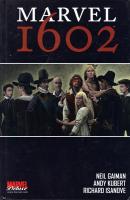
The hardbound edition features a scratchboard illustration depicting the main characters whispering discreetly to each other on the cover. According to McKowen, the image was inspired by a depiction of the masterminds behind the "Gunpowder Plot", an attempt to blow up Parliament during the reign of King James.[7] Since the characters of the story are all traitors in the eyes of King James, they were drawn in a similar fashion.[7]


[edit] Synopsis

[edit] Plot

The story takes place in the year 1602 in the Marvel Universe, where, for an unknown reason, superheroes have appeared about 400 years early[4], though they were born and bred in this era and some hold important positions in high places. When the characters come to realize that something is wrong with the universe, the heroes must solve the mystery behind their own existence, while dealing with intrigue at the courts of Elizabeth and James.

All over Europe, strange weather is provoking panic. Many believe the unnatural occurrences are the beginning of the Apocalypse. Dr. Stephen Strange, the court magician of Queen Elizabeth I, senses that there are unnatural forces at work. He also comes to learn that the secret treasure of the Knights Templar is being moved from Jerusalem to England; Elizabeth tells her head of intelligence, Sir Nicholas Fury, to bring the weapon to England safely. Fury in turn contracts Matthew Murdoch to rendezvous with the Templar guard and secure the weapon. On the road, Fury and his assistant, Peter Parquagh, are attacked by an assassin, whom Fury disables and locks in the Tower of London. Meanwhile, the ship Virginia Maid arrives in England from the New World, carrying the young Virginia Dare, the first child born in Roanoke colony, as well as her hulking Native American bodyguard Rojhaz. When a flying assassin tries to snatch Dare, Rojhaz quickly disables the killer, but Virginia has transformed into a white gryphon. Rojhaz subdues Virginia, and Strange bespells her to human form before Fury sees her transformed. She has strange shapeshifting powers, and Strange suspects she is the cause of the disastrous weather. Fury interrogates one of the assassins to learn who sent him; Fury learns that Otto von Doom, ruler of Latveria, is behind the attempted killings, but is too late to stop one of Doom's machines from killing Elizabeth.

James VI of Scotland lusts after the Queen's throne, and with Elizabeth's death will rule both England and Scotland. James is distrustful of "witchbreed" and collaborates with Spanish High Inquisitor Enrique to blame the witchbreed of England, headed by Carlos Javier, for Elizabeth's death. Fury, though unwilling to capture Carlos and his students, is forced to take the witchbreed to the Tower. Strange, Javier, and Fury meet in the Tower and discuss how to save the world- which will almost surely lead to them being branded traitors by James. Strange has learned that the treasure of the Templars and its keeper, Donal, and Murdoch, have been betrayed and are now in the hands of Doom. Strange also learns that Doom has been holding captive four heroes from the ship Fantastick, including Fury's friend Sir Richard Reed. Knowing that James will never give him an army to march on Latveria, he conspires with the witchbreed, taking a ship levitated by Javier and his page John Grey across the continent. Strange is confronted by the Watcher, who tells him that the strange events are due to an anomaly he calls the "Forerunner". The Forerunner is from the future and his presence in the past has disrupted reality to the point of impending annihilation of not only Strange's world but all other universes as well. The Watcher forces Stephen to enter a pact that will not allow him to repeat what he has learned for as long as he lives.

Fury, Javier and his witchbreed launch a successful attack on Count Doom's fortress. The Fantastick Four are freed, and Doom is horribly scarred by what he believes is the Templar's treasure; in fact, Donal's walking stick is the true treasure, and using it Donal becomes the Norse god Thor. Having nowhere else to go, the ship of fugitives heads for the New World. In Spain, Enrique is betrayed as witchbreed himself and is to be burned at the stake with his young acolytes, Petros and Sister Wanda. Enrique breaks their bonds and the witchbreed escape on a ship of their own, which seems bound for America as well.

Sir Stephen Strange is executed by James, and his head put on a pike. With his magic, his spirit can still communicate in a telepathic way. His wife Clea takes his head from the pike and sets off for America with Virginia and Rojhaz. Clea believes that Strange's suspicions were wrong: Virginia is not the Forerunner, it is her blond-haired, blue-eyed "Native American" companion Rojhaz.

Rojhaz is in fact Steve Rogers, the future costumed crime fighter known as Captain America. After fighting against a future fascist government of the 21st century, Rogers was captured and placed into a machine which should have killed him but instead sent him into the present timeline. His presence has not only brought about a rift that will destroy the universe, but it also caused the heroes of the twentieth century to appear centuries earlier to counter the Forerunner's negative effects.

Fury and company arrive at the Roanoke colony, where they discover the rift that is tearing their universe apart. Javier, realizing that his enemy Enrique may be the key to manipulating the rift and thus saving the universe, traps him and his followers in their ship. However, it is the former inquisitor who dictates terms.

James sends his advisor David Banner and Peter Parquagh to America with orders to kill Fury. When it arrives in America, Fury single-handedly kills all its members aside from Banner and Peter. In spite of this, Fury has almost lost the will to live: he failed to protect his Queen, he has been made a traitor to his country and all his wealth and property has been seized and taken over by James and his favourites.

Donal meanwhile turns to alcohol, devastated at the fact that he has brought about a god who, according to Donal's religion, should not even exist. However, the final component needed to deal with the rift is lightning and Donal is pushed into turning into the Viking god once more.

Rojhaz, looking more and more like the Cap of old, refuses to go back through the rift: he hopes to build a better America from the beginning. Fury tricks Rojhaz by playing on the trust that Rogers had for the Nick Fury of his own time, knocks him unconscious and carries the body back through the rift, thus going into the future himself.

The rift and the universe restore themselves, meaning the destruction of the alternate timeline; however, Uatu the Watcher is granted a "pocket universe" by his colleagues in which the 1602 timeline remains intact, and where the powered fugitives decide to settle in the Roanoke colony, declaring it a free place for all. Intrigued by the continuing events, Uatu continues to watch the new universe.

[edit] Characters

1602 features both historical figures and many of the original Marvel superheroes and villains. Some popular characters, such as Wolverine, were not added, because of Gaiman's vision to address the heroes of the 1960s. "The territory doesn't go much further than 1969 in terms of the characters that I picked to use," Gaiman noted. "I couldn't get everybody in because there are an awful lot of Marvel characters."[4]

  • Elizabeth I of England: The aging Queen of England. Already close to death, she is killed by Otto Von Doom.
  • James I of England: Originally King of Scotland, James becomes the monarch over England as well with Elizabeth's death.
  • Virginia Dare: The daughter of Ananias Dare, and the first English child born in the Americas. In this world, the Roanoke Colony did not disappear in the 1580s; Dare touches the rift caused by Roger's arrival and gains the ability to transform into animals.
  • Uatu, the Watcher: A younger member of a race of intelligent beings who have sworn not to interfere in the affairs of lesser races, only to watch and observe.
  • Sir Nicholas Fury: The Queen's intelligence officer, and responsible for foiling many past plots against the monarch.
  • Doctor Stephen Strange: The Queen's Physician, who is also a magician and alchemist.
  • Peter Parquagh: Sir Nicholas' apprentice; left orphaned and tended to by his aunt and uncle until Fury arrived and took the boy to London.
  • Matthew Murdoch: A blind Irish minstrel who moonlights as a freelance agent. Matthew acquired heightened senses from a mysterious substance he encountered as a child.
  • Clea Strange: Stephen Strange's wife and assistant, Clea actually comes from another dimension.
  • Rojhaz: Virginia's blonde-haired, blue-eyed Native American bodyguard, who in fact is a displaced Captain America from a dystopian future.
  • Carlos Javier: A Spaniard living in England, where he runs a "College for the Sons of Gentlefolk", in fact a haven for "witchbreed", or mutants). His students include Roberto Trefusis, Scotius Summerisle, Hal McCoy, Werner, and "John" Grey, who is in fact a woman.
  • The Four from the Fantastick: A band of explorers who gained powers associated with the elements. The four are Captain Benjamin Grimm (Thing), Sir Richard Reed (Mister Fantastic - Reed Richards), Susan Storm (Invisible Woman), and John Storm (Human Torch), Their bodies were reshaped into the four elements: Reed's flesh became pliable like water; Grimm's body became solid rock; Susan's body became weightless and invisible like air; and John's body became living fire. They are eventually captured by Doom.
  • Grand Inquisitor Enrique: Born a Jew, Enrique was forcibly baptized by a Christian priest and as an adult leads the Spanish Inquisition. Although ordered to execute the witchbreed, he hides those whom he can pass off as normal. Secretly a witchbreed himself, he uses his activities as a cover to form a "Brotherhood Of Those Who Will Inherit The Earth". He is assisted by Sister Wanda and Petros, who are secretly his children. He is also aided by Toad.
  • David Banner: An advisor to King James, Banner is sent to Roanoke in order to kill Fury. He is transformed by energies which turn him into a massive creature, the Hulk.
  • Count Otto von Doom: Doom is the ruler of Latveria, known as Otto the Handsome. He captures the Fantastic Four in order to use Richard's mind to create war machines and poison.

[edit] Reception and legacy

The first issue of 'Marvel 1602' was ranked first in August 2003 period with pre-order sales of 150,569. [8]

1602 was critically praised upon its release with Comics Bulletin declared that "1602 is a watershed moment in comic book history that will be mentioned in the same breath as Watchmen and The Dark Knight Returns.[9] Entertainment Weekly declared that the combination of writing and moody artwork meant "the Marvel Universe hasn't been this engrossing in ages."[10] ShakingThrough.net noted that fans looking for elements of Gaiman's The Sandman would be disappointed; "It's not a senses-shattering Marvel epic, but then it's not meant to be. It's nothing more or less than a chance to enjoy reinterpretations of some familiar characters."[11] UGO Networks concurred, stating "there doesn't need to be a 'point' in re-imagining familiar icons — it's simply meant to be fun. [...] The result of 1602 is agreeable entertainment."[12] The series won several awards, including the Quill Book Award for Graphic Novels.[13] The first issue was also awarded the 2003 Diamond Distributors Gem Award as "Comic of the Year".[14]

Conversely, Time Magazine listed it as the worst comic of 2003,[15] although the list's composer later stated "he didn't actually mean it was the worst comic of the year." UGO's Darren Latta noted as a downside to the series that "the approach maybe a little too subdued at times." Latta also felt that despite being familiar with the setting, Gaiman never utilized the period to its full potential.[12] Others simply felt that Gaiman's involvement led to inflated expectations; one review noted that while reading "I [...] felt at times like maybe it was all a little bit too cute, a little bit too in-jokey."[16]

1602's success lead to two sequels. The first, 1602: New World, takes place shortly after the end of 1602, with the heroes settling down in America. The series was written by Greg Pak and illustrated by Greg Tocchini, and the first issue was published in August of 2005. The second sequel, Marvel 1602: Fantastick Four was written by Peter David and pencilled by Pascal Alixe. The story involves the Fantastick Four's adventures in London, the return of Otto Von Doom, and the "Four Who Are Frightful."

[edit] See also

[edit] References

  1. ^ McKowen, Scott. "Cover Process", from Marvel 1602: page 3.
  2. ^ a b c Gaiman, Neil (2004-06-30). "Afterword", from Marvel 1602: page 1.
  3. ^ Gaiman, Neil (2004-06-30). "Afterword", from Marvel 1602: page 2.
  4. ^ a b c d Weiland, Jonah. (2003-06-27). "Marvel's '1602' Press Conference". Comic Book Resources. Retrieved on 2008-02-18.
  5. ^ a b Lowe, Nick. "Pencils", from Marvel 1602.
  6. ^ a b McKowen, Scott. "Cover Process", from Marvel 1602: page 1.
  7. ^ a b c McKowen, Scott. "Cover Process", from Marvel 1602: page 2.
  8. ^ "Top 300 Comics Actual--August 2003". icv2.com (2004-09-16). Retrieved on 2008-07-16.
  9. ^ Dolan, Cody (2003-08-25). "1602 #1 Review". Comics Bulletin. Retrieved on 2008-01-23.
  10. ^ Jensen, Jeff (2003-09-05). "Book Capsule Review: 1602 (Summer 2003)". Entertainment Weekly. Retrieved on 2008-02-13.
  11. ^ "The Gentleman" (2005-08-13). "Somewhere in Time". ShakingThrough.net. Retrieved on 2008-02-20.
  12. ^ a b Latta, Darren (2004). "Featured Review: 1602 (Marvel Comics)". UGO Networks. Retrieved on 2008-02-20.
  13. ^ Quills Foundation (2005). "The Quill Awards: The 2005 Awards". TheQuills.Org. Retrieved on 2008-02-12.
  14. ^ Brady, Matt (2004-03-31). "Diamond Names 2003 Gem Award Winners". Newsarama. Retrieved on 2007-01-31.
  15. ^ Arnold, Andrew (2003). "Time 2003 Best and Worst: Comics". Time Magazine. Retrieved on 2008-02-12.
  16. ^ Lander, Randy (2003-07-10). "Snap Judgements: Marvel 1602". TheFourthRail.com. Retrieved on 2008-02-12.

[edit] External links


Un article de Wikipédia, l'encyclopédie libre, distribué sous license GFDL (liste des auteurs)
Pour accéder à la version originale de cet article ou pour participer à Wikipédia, il sous suffit de suivre ce lien
An article from Wikipedia, the free encyclopedia, distributed under GFDL (authors)
To view the original version of this article or to improve Wikipedia, just follow this link

Comics VF L'encyclopédie des comics en version française
Comics VF
Présentation
Statistiques
Contributions
Articles
VF en cours
Par titre
Par éditeur
Nouveautés VF
Toutes les VF
Par titre
Par éditeur
Index des éditeurs
Cover galleries
VO
Par titre / Par éditeur
Par auteurs
Index des éditeurs
Cover galleries
Rechercher avec Google

Web CVF

Contacts
Index H. Drake
Scans M. Racaud
Navig.
Accueil
Retour
Music VF

Variété internationale, Pop, Rock, Dance, Soul, Hip-Hop, Country
Tous les hits US et britanniques de 1952 à aujourd'hui

Comics VF
© 1998-2006 Howard Drake & Michel Racaud